
Standard or Custom Fleet Build: Which One’s Right for You?
If you need to grow your rental fleet fast and keep costs predictable, a standard build is likely your answer. If your site has unique requirements that a standard unit can’t accommodate, a custom build will save you money in the long run.
Here’s the short version:
Standard builds = faster delivery, consistent pricing, same layout across every site
Custom builds = built around your workflow, site conditions, and non-negotiable equipment needs
The wrong choice costs you — either in missed timelines or inefficient operations. This article walks you through exactly how to decide.
Ready to talk fleet?
This article walks you through exactly how to decide. Read the rest of the article below.
Here are some insights from the field to help you make a smarter modular investment. Because when industrial and commercial operators come to ROC Modular looking for a fleet solution, one of the first questions we work through together is deceptively simple:
“Do you need something standard, or does your operation require something built specifically for you?”
It sounds like a straightforward choice. In practice, it’s one of the most consequential decisions in the procurement process and getting it right early saves significant time, money, and operational headaches down the road.
What follows is a distillation of what we hear from our client partners every day, and what we want you to know so you can walk into that
What we hear
After working with operators across resource extraction, construction, utilities, and industrial services, two camps emerge clearly.
- Camp 1 comes to us with a hard mobilization date, a defined number of units, and a clear directive to stay within budget. Consistence matters to them. They need their site supervisor in Fort McMurray and their site supervisor in Red Deer to walk into functionally identical spaces. Predictability is the product.
- Camp 2 comes with a site plan, a headcount breakdown, a list of equipment that has to live inside the structure, and a workflow they’ve refined over years. Their operation doesn’t fit a standard footprint. Forcing it would cost them more in lost efficiency than any premium on a custom build.
Both are right. The answer isn’t which approach is better. It’s which approach is right for your operation.
Standard Fleet Builds
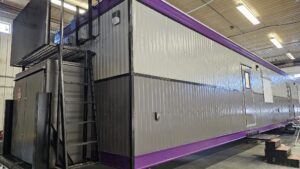
This is when speed and consistency wins. They’re the right choice when three things are true:
- Your timeline is tight.
- Your budget needs to stay predictable.
- You’re deploying multiple units that need to function the same way.
The Speed Advantage
Standard designs move quickly through procurement, fabrication, and delivery because the decision-making is already done. There are no design reviews, no engineering sign-offs on custom configurations, no back-and-forth layout changes. When your mobilization window is measured in weeks rather than months, that efficiency is real helpful.
Cost Predictability Across a Fleet
For operators managing capital expenditures across multiple sites or multiple phases of a product, cost variability is a serious risk. Standard builds reduce that risk substantially. You know what a unit costs. You know what a fleet of twelve costs. There are no change orders driven by unique specifications, no material premiums for one-off configurations.
When finance needs to model the capital spend and operations needs to plan the rollout, standard builds give both team numbers they can rely on.
Consistency at Scale
There’s an under-appreciated operational benefit to fleet consistency:
Your people know the space.
A maintenance technician who services units across multiple sites doesn’t have to relearn a layout. A site manager rotating between locations works in familiar surroundings. Training materials apply across the fleet. That consistency is something that compounds over time.
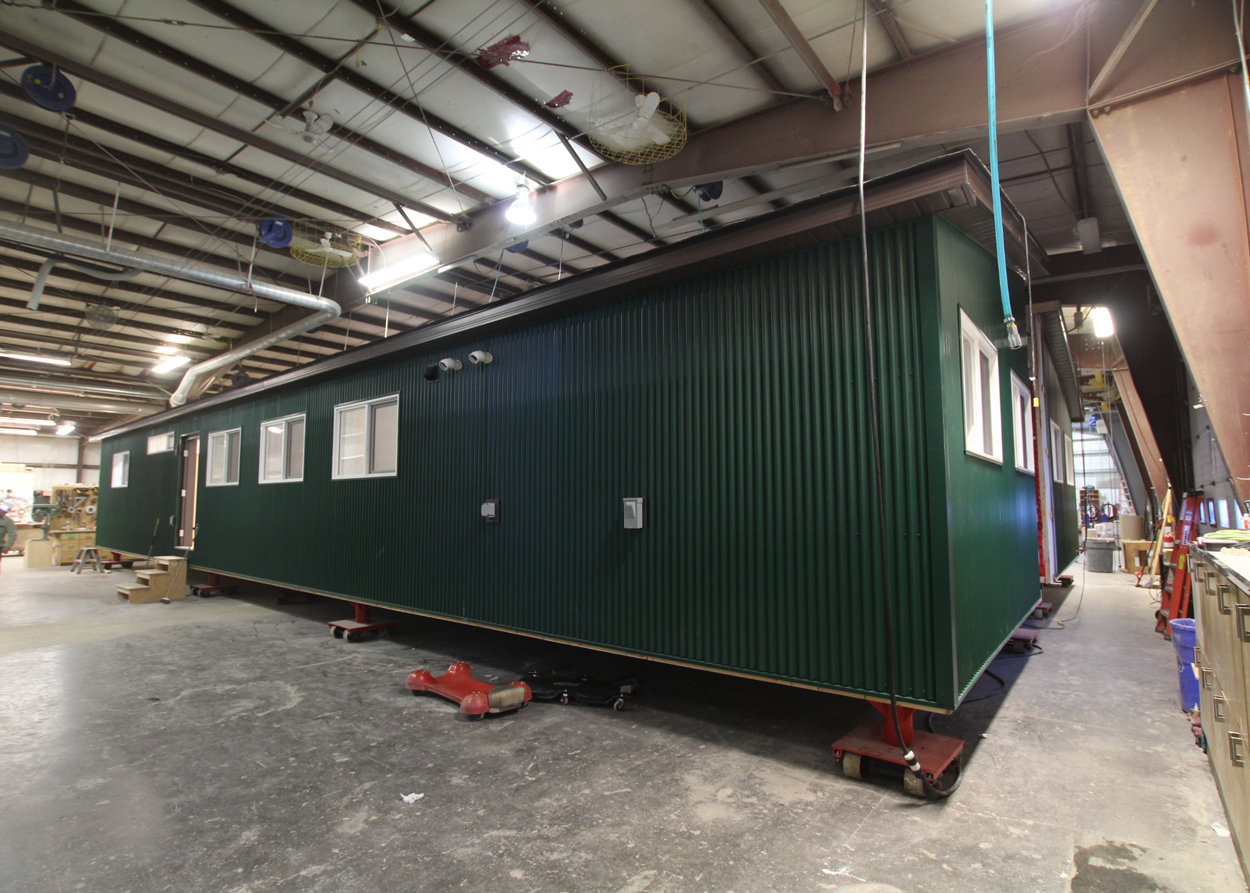
Here’s an example from our portfolio: Fleet Offices 12×40, Alberta
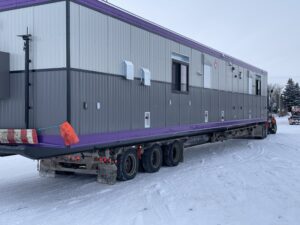
A fleet operator came to us needing ten 12×40 frameless site offices added to their existing deployment. The requirement was straightforward in that the units were built to their established design and specifications, finished to their company branding standards, and engineered to hold up under repeated relocation between sites.
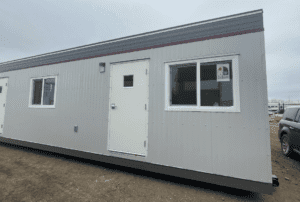
There was no need to reinvent the layout. The client knew exactly what worked operationally and the priority was replicating it reliably at scale and on schedule. That’s exactly what a standard fleet build is designed to deliver.
View the Fleet Offices 12×40 project here
Custom Builds
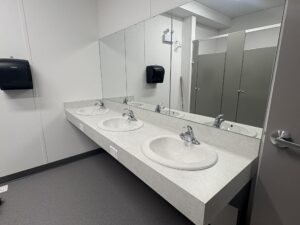
Custom builds are driven by the fact that an operation doesn’t fit the standard box (literally and figuratively).
Site Conditions That Dictate Design
Some sites present physical constraints that a standard layout simply can’t accommodate. Access road dimensions, foundation requirements, prevailing wind direction relative to HVAC placement, proximity to process equipment. These are all real variables that shape what a structure needs to be, and they’re not solvable with a catalogue product.
Workflow and Headcount Requirements
The way your people work matters. A crew that needs a large central briefing space, dedicated equipment storage, and separated office functions for supervisors has fundamentally different requirements than a maintenance crew rotating through eight-hour shifts in a smaller footprint.
When the layout has to support the workflow, custom is the answer.
Non-Negotiable Integrations
Maybe specific equipment has to live inside the structure. Whether that’s specialized HVAC, a tool crib with fixed dimensions, industrial washrooms to regulatory specs, or communications infrastructure, you can’t retrofit equipment requirements into a standard design after it’s built. It’s better (and cheaper) to build for them from the very start.
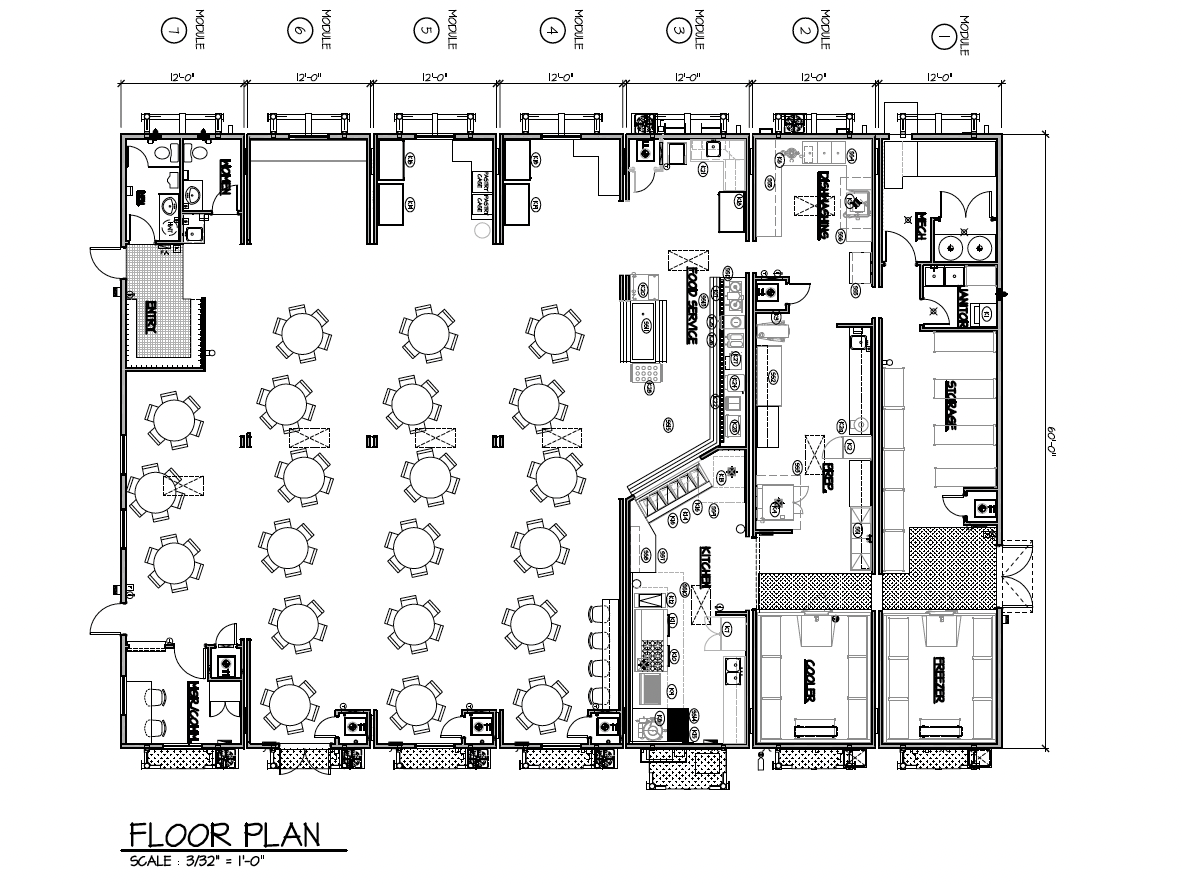
Here’s a custom example from our portfolio: 8-Unit Office Complex, Yukon
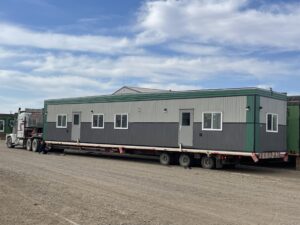
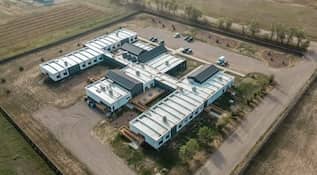
When a client came to us needing a high-end industrial office fleet built for the Yukon, standard wasn’t going to cut it. The project called for an 8-module complex spanning 5,760 sq. ft. — built to the client’s exact specifications, finished to their brand colours, and engineered specifically for Northern climate conditions.
The interior had to meet a level of finish well above a typical site office: custom cabinetry, modern finishes, and details that reflected the client’s brand standards throughout. Every decision was driven by what the client’s operation actually required, not what fit a catalogue.
A standard build wouldn’t have served this client. The climate demands, the interior specifications, and the brand requirements all pointed in one direction: design and build to fit.
View the 8-Unit Office Complex project here
The Timeline Tradeoff: What to Expect
This is where we have the most direct conversations with clients, because timeline expectations need to be calibrated before a project starts… not after.
Standard builds move faster because the design phase is already complete. Procurement, fabrication, and delivery can proceed without the iterative coordination that custom projects require. For tight mobilization schedules, this is often the deciding factor.
Custom builds require upfront investment in planning. Design reviews, site-specific engineering, layout approvals. These add time at the front of the project. The critical insight: that time spent upfront is not wasted. It’s time that prevents costly changes, delivery delays, and operational compromises later.
The question we always ask clients:
“Where does the cost of delay hurt more before mobilization or during operations?”
The answer tells us a lot about which path is right.
The Budget Tradeoff: Cost vs Fit
Budget discussions around standard versus custom often start in the wrong place. The comparison isn’t simply purchase price, it’s total cost of ownership against operational fit.
Standard builds control cost variability. Unit price is known. Fleet price is known. There are no surprises. For organizations where capital budget predictability is non-negotiable, this matters enormously.
Custom builds may carry a higher upfront cost but that premium often pays back quickly when the alternative is an ill-fitting standard unit that compromises daily operations. A layout that forces inefficient workflows, inadequate storage, or non-compliant equipment integration isn’t actually cheaper. It’s just cheaper to purchase.
The right frame:
“What does each option cost you per productive day of operation over the life of the asset?”
Five Questions to Ask Before You Decide
Based on what we hear from our client partners, these are the questions that cut through the noise and get you to the right answer faster.
- How many units do you need now, and how many might you need in the next 18–24 months? Scale changes the calculus. A single unit with specific requirements might justify custom. A fleet of ten units with modest requirements might not — unless those requirements are consistent enough to justify a custom standard.
- Do you need to match an existing fleet? If you’re adding units to an existing deployment, matching matters. Your teams expect consistency, your spare parts are standardized, and your operational procedures are already written. Custom units that diverge from your fleet create complexity that compounds over time.
- Are there layout or equipment requirements you cannot compromise on? Be honest about this one. Some requirements are genuine non-negotiables — regulatory, safety, or operational. Others are preferences that can flex. Knowing the difference before you get into procurement saves everyone time and money.
- What’s your real mobilization date and what’s the consequence of missing it? Not the aspirational date. The real one, with real consequences attached. If missing that date costs you a contract, triggers penalties, or delays production start, the timeline math changes significantly.
- Who else needs to approve the specification? Custom builds involve more stakeholders — engineering, HSE, operations leadership, sometimes the end client. If those approvals take time, that time needs to be built into the schedule. It doesn’t disappear just because it’s inconvenient.
What We’d Like You to Know
The decision between standard and custom isn’t a judgment about the sophistication of your operation. We’ve worked with some of the most complex industrial operators in Western Canada who’ve chosen standard builds. We’ve worked with straightforward operations that needed something purpose-built because of a single non-negotiable site constraint.
What matters is matching the solution to the reality, not to a preference, not to a preconception, and not to what was done on the last project without checking whether the conditions are the same.
When you’re ready to have that conversation, we’re ready to have it with you.